

“Last year, the conversation was about survival. This year, it’s about endurance.”
That line from Anamika Gadia, Partner and National Leader of Industrial Markets at KPMG Canada, captures exactly where the manufacturing sector sits in mid-2026. A July survey of 275 Canadian manufacturers found that 52% describe their operations as being in endurance mode: absorbing costs, holding steady, waiting for the uncertainty to resolve before making consequential decisions. Fifty-seven percent have paused, reduced, or cancelled capital investment projects. Forty-two percent have scaled back or paused research and development spending.
The instinct behind those decisions is rational. When trade uncertainty is high, tariff exposure is real, and demand signals are mixed, a defensive posture feels like prudent risk management. But endurance mode has a cost that doesn’t show up in the decisions being deferred. It shows up in the workforce, quietly, over time, and often in ways that become visible only after the damage is done.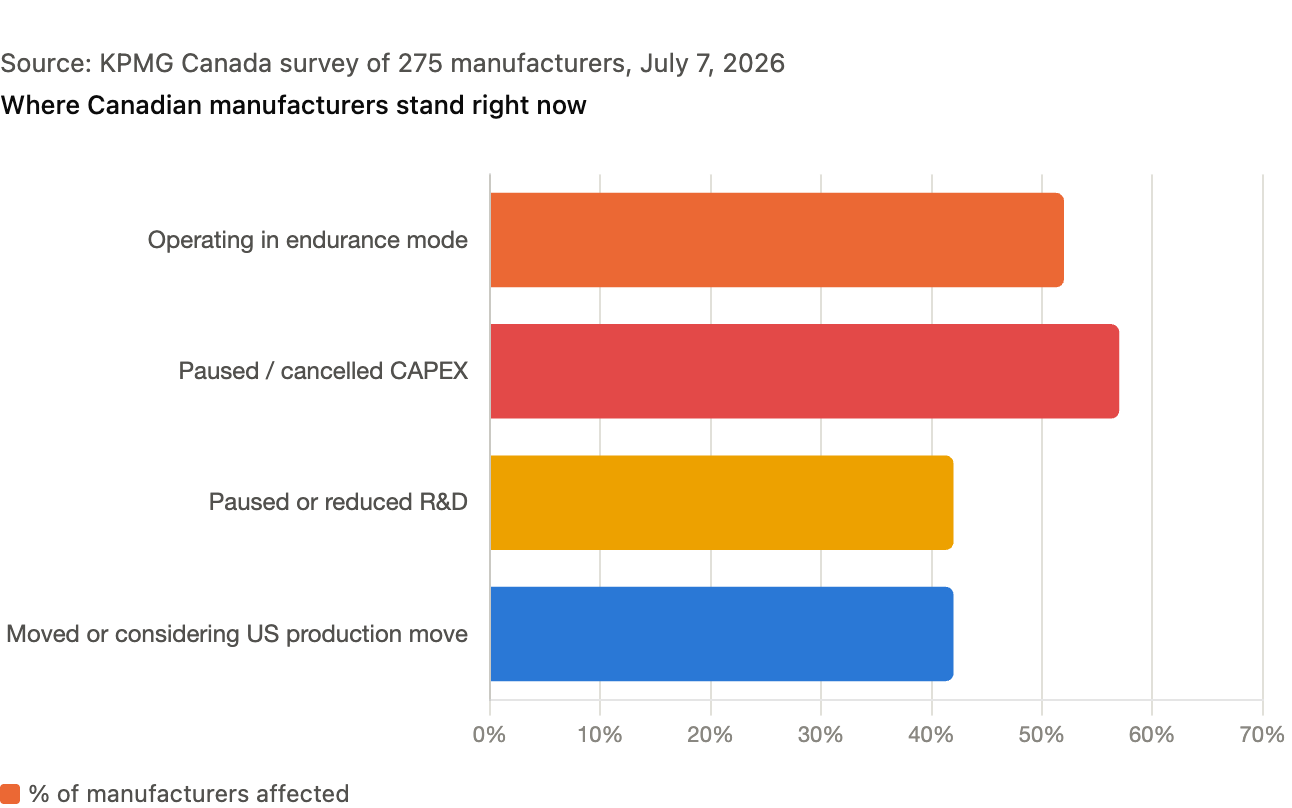
The Top Performers Leave First
The most consequential and least discussed cost of a prolonged defensive posture is who leaves during it.
A Harvard Business Review analysis of more than four million employee records found that one in four employees who resign are high performers. That figure rises to more than one in three after a higher-paid new hire joins the team. Top performers resign more than twice as fast when companies delay adjusting existing employees’ pay relative to what the market is moving. And Payscale’s 2026 Compensation Best Practices Report found that 33% of employers say pay compression between newer and longer-tenured employees contributes to workers perceiving their pay as unfair.
In endurance mode, compensation reviews get deferred. Merit increases get compressed or cancelled. The budget pressure is real and the rationale is defensible. But what organizations don’t account for is who notices first. Top performers track the market. They talk to recruiters. They read salary transparency disclosures. They are, by definition, the people with the most options: and they are the first to exercise those options when they conclude that staying is no longer rational.
The workers who stay through a period of compensation stagnation are disproportionately those who have fewer external options. That sorting effect, barely perceptible in real time, produces a workforce that has been quietly drained of its highest contributors over 12 to 24 months. When the market recovers and production demands surge, the operation is trying to scale with a team that was already its second and third choices.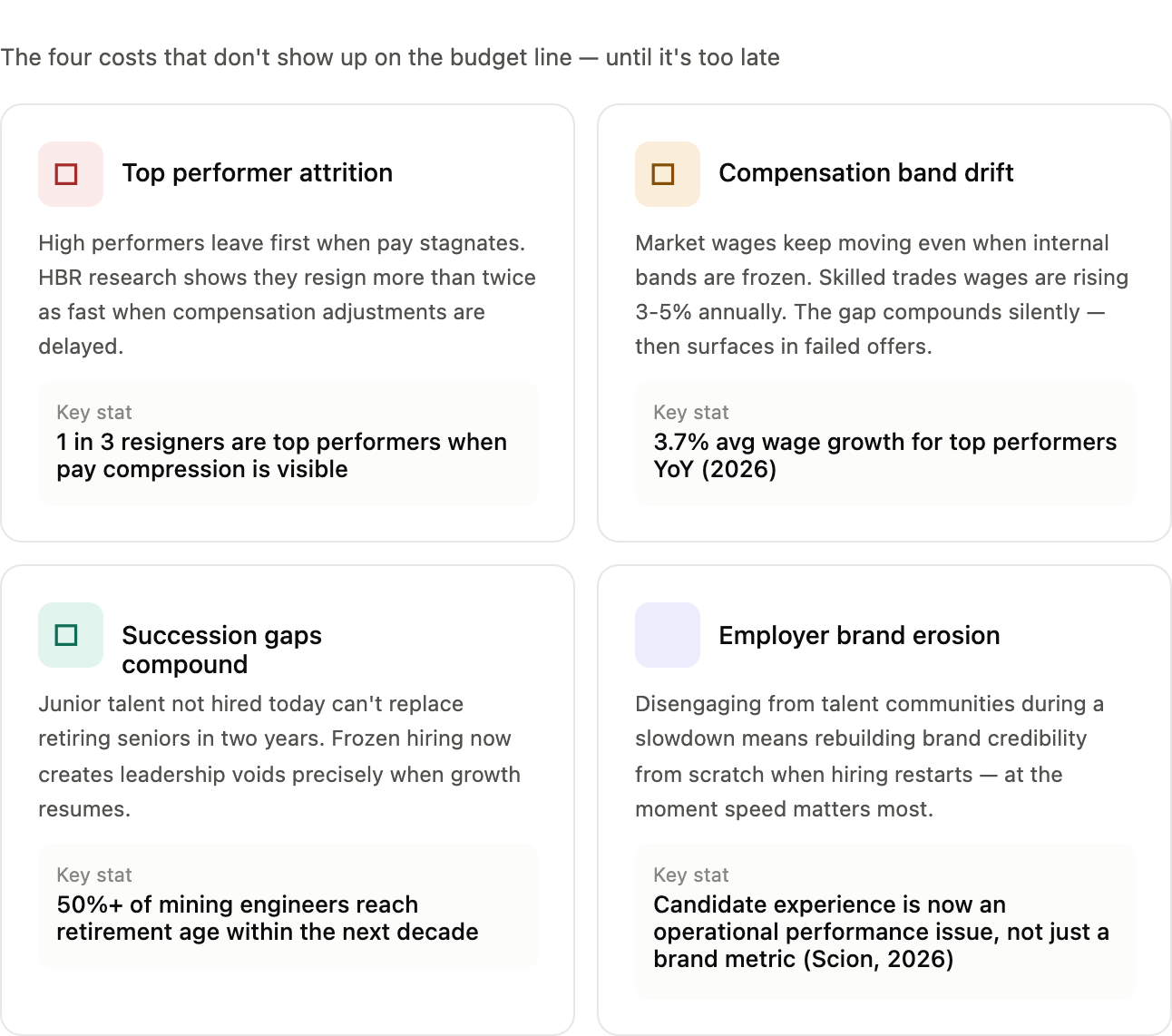
Compensation Bands Drift Below Market While You’re Not Looking
Wages for skilled trades and production roles are not pausing because manufacturers are in endurance mode. Mercer’s 2026 compensation analysis found that front-line, on-site, and skilled trades roles continue to experience persistent wage pressure, with employers taking a more aggressive stance on pay to attract and retain workers required to maintain operations. Wages for top performers broadly are up roughly 3.7% year-over-year across North American industrial sectors.
An organization that freezes its compensation bands while the market moves upward by 3 to 5% annually doesn’t notice the drift in year one. By year two, it’s struggling to close offers. By year three, it’s losing candidates it would have retained two years earlier, and it’s paying well above its internal bands just to stay competitive on new hires. That gap between what new hires earn and what long-tenured employees earn then triggers the top performer attrition dynamic described above, completing a cycle that started with a defensible budget decision and ends with a materially weaker team.
Ontario’s pay transparency legislation, now requiring salary ranges in job postings for employers with 25 or more employees, has made this dynamic more visible and more consequential. When candidates and current employees can see the posted range for a new hire in an equivalent role, the compensation compression that might previously have stayed invisible is now a retention risk that can trigger departures immediately.
Succession Gaps Compound Silently
The manufacturing and industrial workforce is aging. More than half of the US mining workforce will retire by 2029. Canada faces a shortage of 80,000 to 120,000 mining workers by 2030. Manufacturing’s most experienced operators, maintainers, and technical leads are in the final years of their careers across both countries.
In a well-functioning workforce strategy, succession planning addresses retirement risk proactively. Junior and mid-level talent is developed on a timeline that accounts for senior departures before they create operational gaps. Knowledge transfer programs capture institutional expertise while the people who carry it are still present.
Endurance mode disrupts that timeline. When hiring is frozen or dramatically slowed, the junior talent that would have been developing into the roles vacated by retiring seniors doesn’t arrive on schedule. When training and development budgets are cut alongside capex, the knowledge transfer that should be happening doesn’t. When the senior technician, mine planner, or process engineer retires, the vacancy is real, the institutional knowledge walks out with them, and the organization discovers it has a crisis rather than a transition.
This is the succession gap that compounds silently. It doesn’t show up on a budget line until the retirement happens. By then, the 18 to 24 months of development time that would have prepared an internal successor is simply not available, and the operation is recruiting externally at peak urgency, paying premium compensation to find experience it could have developed internally for considerably less.
Employer Brand Erodes in Markets That Don’t Forget
The talent market in industrial sectors is small enough that reputation travels. How a company treats candidates during a hiring slowdown, whether it communicates clearly, whether it maintains a professional recruiting experience, whether it stays engaged with its talent community even when it isn’t actively hiring, shapes what candidates think of that organization when conditions change and it needs to hire aggressively again.
Organizations in endurance mode often disengage from talent community activities: they stop attending industry events, pull back from university partnerships, reduce their social media presence as an employer, and let relationships with staffing partners go cold. None of those decisions feel consequential in the moment. Collectively, they produce an employer brand that has to be rebuilt from scratch when the recovery comes, at exactly the moment when speed and credibility matter most.
Scion Staffing’s July 2026 industry analysis noted that candidate experience has shifted from a branding topic to an operational performance issue. Slow processes are interpreted as indecision. Vague job descriptions signal internal misalignment. Candidates share hiring experiences within professional communities that, in mining, manufacturing, and semiconductor, are tightly connected. An organization known for a slow, impersonal, or disorganized recruiting process during a downturn will find its candidate conversion rates lower than expected when the market tightens again.
What Happens When the Market Recovers and You’re Not Ready
Canada’s manufacturing PMI (Purchasing Managers’ Index) reached a 13-month high of 51.0 in February 2026. The US ISM Manufacturing PMI hit 54 in May 2026, its strongest reading since 2022. The signals of a manufacturing recovery are already present in the data, even as individual companies remain in defensive posture.
The organizations that positioned defensively through the contraction but built and maintained their workforce capabilities will be ready to capture the recovery. The ones that let compensation bands drift, allowed succession gaps to widen, lost their best performers to better-compensated competitors, and disengaged from talent markets will face a specific problem: the production demand is returning before the workforce is ready to meet it. They’ll be competing for the same candidates at the same time as everyone else who waited, in a market where the available talent pool has already been absorbed by the organizations that kept hiring through the uncertainty.
The global skills shortage is already costing businesses an estimated $5.5 trillion in annual revenue, according to MindSpark Learning’s analysis published in Fast Company. For industrial manufacturers, the cost isn’t that abstract. It’s the project that slips because the team isn’t staffed. The expansion that takes six months longer than it should because the workforce isn’t ready. The order that goes to a competitor because the capacity to fulfil it isn’t there.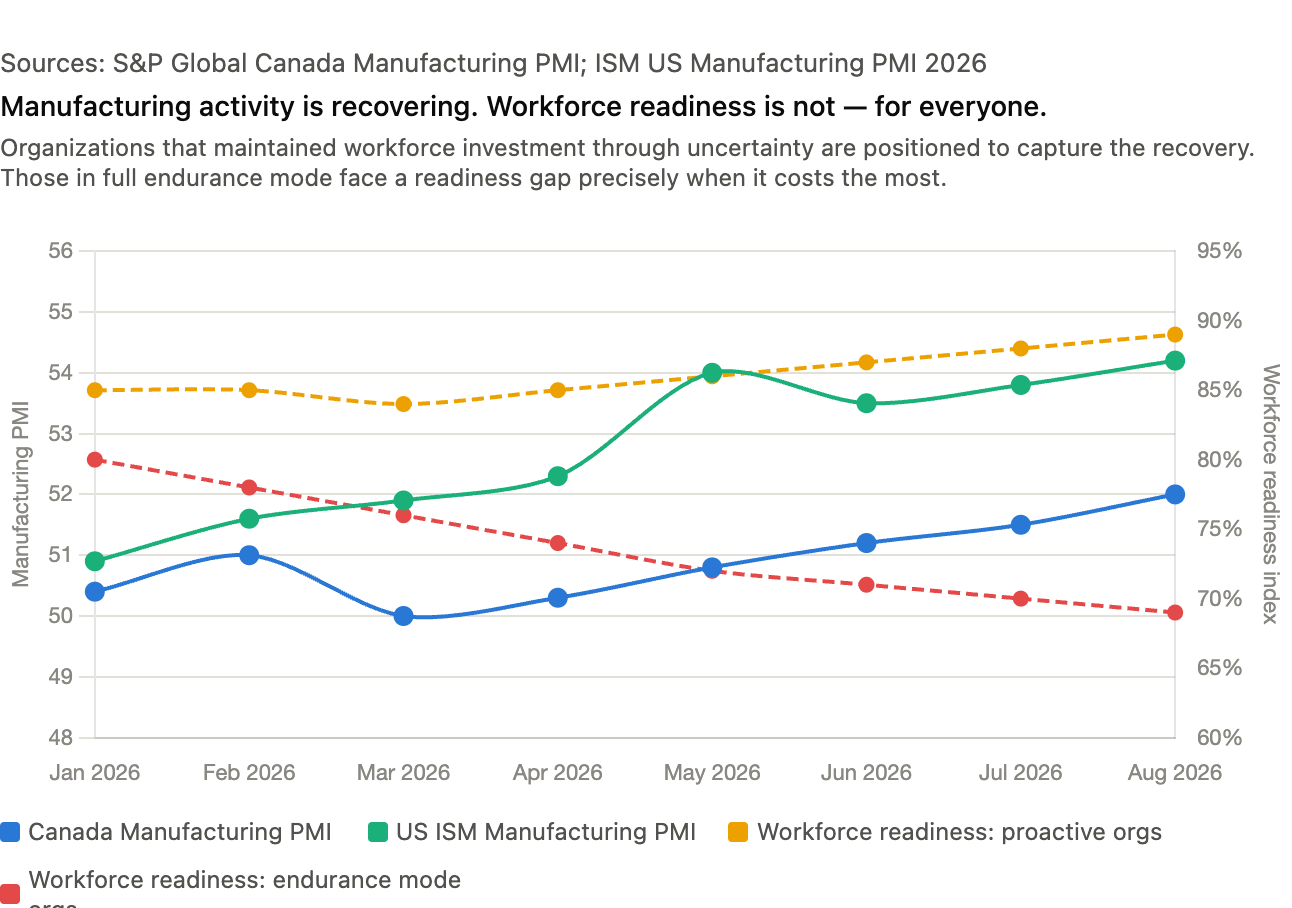
What the Alternative Looks Like
Endurance mode is not the only available response to uncertainty. The manufacturers building the strongest competitive positions through this period are doing something different: they’re treating the uncertainty as an operating condition to manage, not a pause signal to wait out.
That means maintaining compensation benchmarking on a quarterly rather than annual cadence so that drift is caught early rather than after the damage is done. It means continuing to develop internal talent on the timeline that succession risk requires, regardless of whether the capex budget is frozen. It means staying present in the talent communities that will feed their hiring when conditions improve, so that the recruiting relationships and employer brand equity are intact rather than having to be rebuilt under time pressure.
It also means working with a recruiting partner who understands the industrial talent market well enough to be genuinely useful during a period of constraint, not just when positions are urgently open. The organizations that come out of this period with stronger workforces than they entered it will be the ones that treated human capital with the same forward-looking discipline they applied to equipment maintenance and customer relationships when times were difficult.
TPD has worked through multiple cycles of industrial expansion and contraction over 45 years. The companies that used downturns to build workforce capability, rather than let it erode, have consistently been better positioned when the market turned. Tell us how your operation is managing through endurance mode: we’ll outline a workforce strategy that doesn’t wait for the recovery.
Connect with our Manufacturing Workforce Manager, Sepand, to receive a free workforce evaluation.