
The number that should be sitting on every manufacturing operations leader’s desk right now isn’t the PMI reading or the order backlog. It’s this: 20% of US manufacturing plants failed to produce at full capacity last year specifically because of a lack of skilled labour.
Not equipment failure. Not supply chain disruption. Not demand softness. People.
Sixty-five percent of manufacturers across North America rank talent attraction and retention as their single biggest business challenge, ahead of input costs, trade uncertainty, and technology investment. The US manufacturing sector is projected to need up to 3.8 million new workers by 2033, with nearly half of those roles at risk of going unfilled if current trends continue. Manufacturing turnover runs at 26 to 28% annually, and the average cost to replace a single departing employee has reached approximately $35,700 when direct and indirect costs are fully accounted for.
These numbers aren’t new. What is new is the playbook that’s emerging from the manufacturers who are outperforming their peers on hiring speed, retention, and workforce stability despite the same market conditions everyone else is navigating. The difference isn’t budget. It’s process.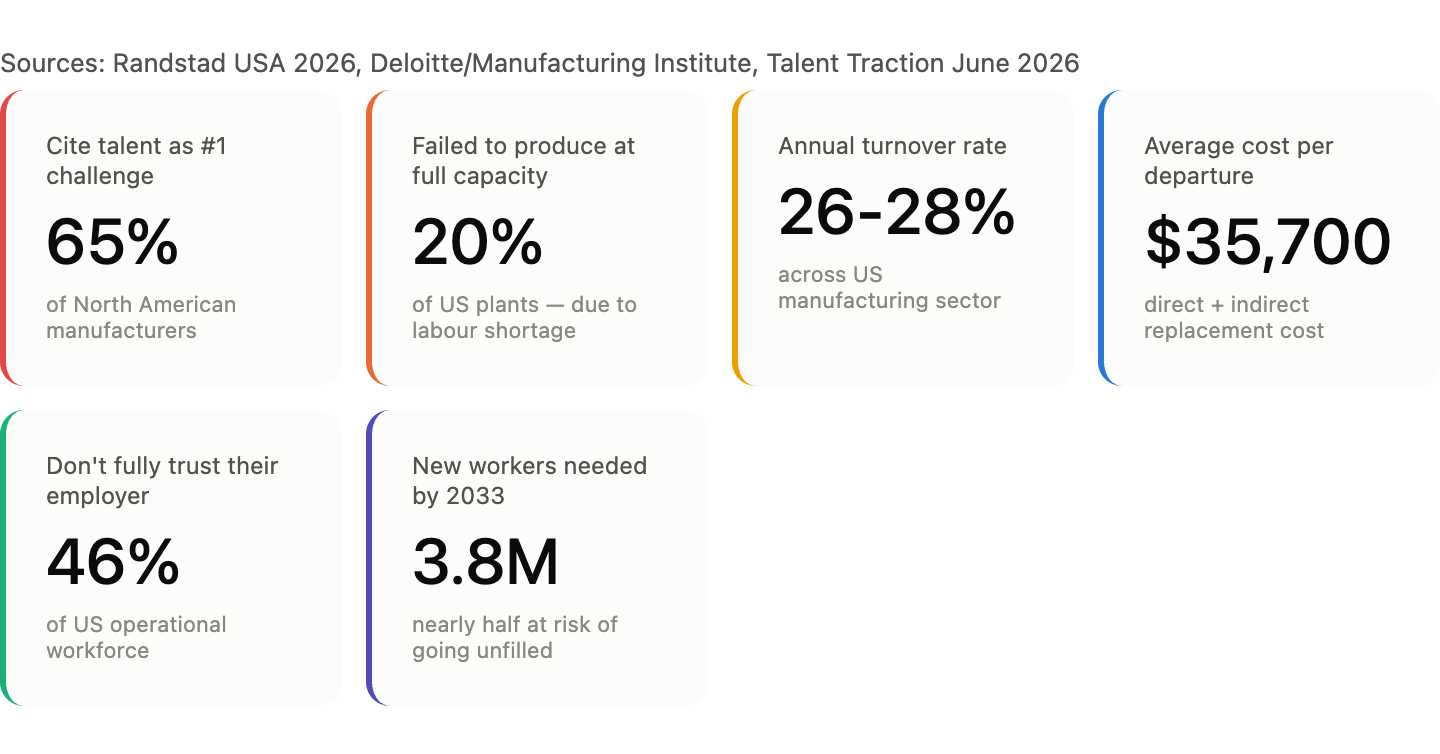
The Problem With How Most Manufacturers Approach This
The dominant approach to manufacturing talent across North America is still reactive. A role opens, a job description gets posted, applications come in at varying quality, and the process starts from zero. When the search takes twelve weeks for a maintenance technician and production is absorbing the gap through overtime, the organization has already paid more in premium labour costs than a more proactive approach would have cost in the first place.
Reactive hiring doesn’t work when the candidate pool for skilled roles is structurally thin. More than one-third of manufacturing executives now cite workforce skills, not workforce volume, as their primary talent concern. The constraint isn’t finding warm bodies. It’s finding people who can actually do the work, and those people are almost always already employed and not actively searching.
The other structural problem is the trust gap. Randstad’s 2026 research found that 46% of the US operational workforce doesn’t fully trust their employer, and that trust deficit translates directly into willingness to leave when another opportunity appears. Manufacturers spending heavily on recruiting while ignoring the conditions that cause their current workforce to look elsewhere are running a leaking bucket strategy that no volume of new hires can sustainably fill.
The playbook that’s working addresses both ends of that equation simultaneously.
Move Hiring Upstream
The manufacturers consistently outperforming their peers on time-to-fill have one practice in common: they build candidate relationships before roles are open, not after.
That looks different depending on the operation, but the mechanisms are consistent. Partnerships with community colleges and technical institutes that produce trades graduates create a pipeline of candidates who know the company before they’ve graduated. Apprenticeship programs that bring people into the organization as learners rather than fully qualified hires develop the workforce the operation actually needs rather than competing for the limited number of people who already have it. Employee referral programs that give existing workers a genuine incentive to recommend qualified people from their networks tap a sourcing channel that consistently produces higher-quality and longer-tenured hires than job boards alone.
The underlying logic is simple. When a role opens in an operation that has built these relationships, the search doesn’t start from zero. It starts from a pool of candidates who already have some familiarity with the environment, have already been assessed at some level, and aren’t simultaneously fielding four other offers. The time-to-fill compresses, the quality of hire improves, and the per-hire cost drops relative to the reactive alternative.
Texas, Georgia, and Florida are projected to see the fastest growth in skilled manufacturing jobs over the next decade, driven by major projects including Samsung’s Taylor facility, Tesla’s Austin expansion, and EV battery production from Kia, Hyundai, and Rivian. In those markets particularly, the manufacturers that have already established community college partnerships and apprenticeship programs before the competition intensifies further will have a measurable structural advantage over those that haven’t.
Redefine What Qualified Means
Overly narrow job criteria is one of the most consistent and most correctable sources of hiring difficulty in manufacturing. A posting that requires five years of experience on a specific machine brand, a particular provincial or state credential, and a degree in a field where there are six graduates per year in the relevant metro area has effectively eliminated 90% of the people who could do the job well with a reasonable onboarding investment.
The manufacturers getting this right have done a specific exercise: for each role, they’ve separated what a candidate genuinely needs to have on day one from what can be developed within the first 60 to 90 days with structured onboarding. The former becomes the actual screening criteria. The latter becomes the onboarding plan. That reframe expands the candidate pool meaningfully for most roles, and it shifts the value question from “how long will it take to find the perfect person” to “how quickly can we develop the right person into full productivity.”
Skills-based hiring in manufacturing also opens access to adjacent talent pools that conventional credential screening excludes. Veterans with electromechanical training. Workers transitioning out of automotive or aerospace. Career changers from industries where manual precision, process discipline, and equipment familiarity exist under different job titles. These candidates require deliberate sourcing and targeted outreach, but they exist in larger numbers than the traditional manufacturing candidate pool and often produce better retention outcomes because the move was intentional rather than opportunistic.
Treat Retention as a Cost Control Strategy
The $35,700 average cost of replacing a single manufacturing employee is the number that reframes the retention conversation for operations leaders who have historically treated it as an HR initiative rather than a financial one.
At 26 to 28% annual turnover, a manufacturing operation with 100 workers is replacing 26 to 28 people per year. At $35,700 per departure, that’s between $928,200 and $999,600 annually in replacement cost alone, before accounting for the productivity loss during the gap, the overtime carried by remaining workers, the quality risk during the new hire’s ramp-up period, or the compounding safety risk of chronically cycling new and undertrained workers through a production environment.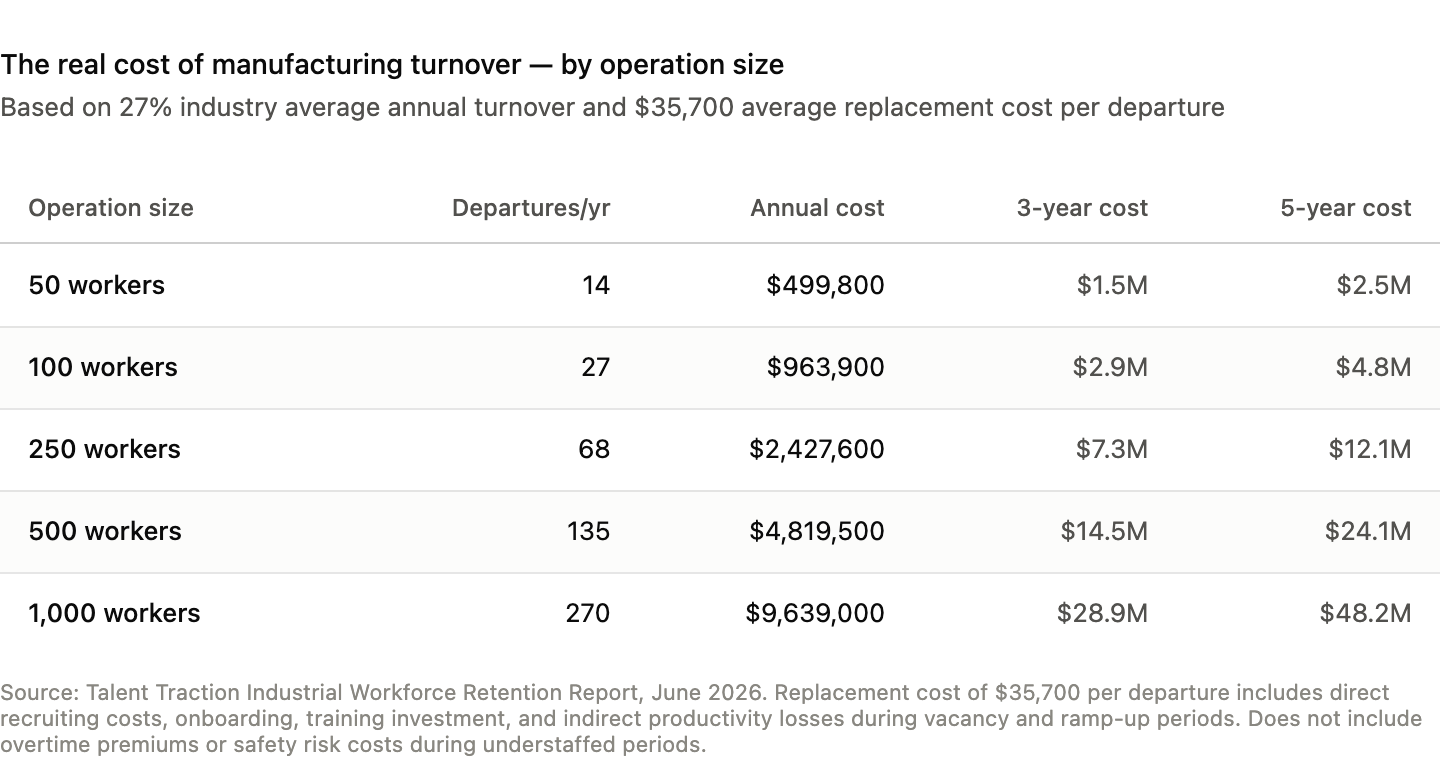
The levers that move retention in manufacturing are well understood from the research, even if they’re inconsistently applied. Schedule predictability is consistently one of the most cited drivers of voluntary departure in industrial settings: workers who can plan their lives around their schedules stay longer than those who can’t. Visible career pathing that shows a credible path from machine operator to technician to supervisor gives workers a reason to invest in the organization rather than treating it as a waypoint. Supervisor quality, a factor often underestimated by senior leadership, is the most direct predictor of whether a good employee stays or leaves: and supervisors can be trained on the specific behaviours that retain people if the organization commits to doing it.
Compensation benchmarking that reflects what the market is actually paying, not what it paid 18 months ago, is a prerequisite for all of it. A retention strategy that sits on top of a compensation structure that has drifted below market will not produce meaningful results regardless of how well everything else is executed.
Build Flexibility Into the Workforce Model
The manufacturing operations navigating demand volatility most effectively in 2026 are the ones that have built contingent workforce capacity into their baseline operating model rather than treating it as an emergency measure.
Temp-to-hire arrangements have become a preferred hiring model for many manufacturers precisely because they allow capability to be assessed in the actual production environment before a permanent commitment is made. The candidate who performs well on the floor over 60 to 90 days is a meaningfully lower retention risk than the candidate who interviewed well and has a résumé that looks right. For a sector where the cost of a bad permanent hire includes weeks of onboarding investment, equipment risk during the learning curve, and the full replacement cost when the hire doesn’t work out, that reduction in hiring uncertainty has direct financial value.
Contract and contingent staffing also gives operations the flexibility to scale labour with production demand rather than carrying full-time headcount through periods of lower output or protecting against volatility by running chronic overtime on the permanent workforce. Randstad’s research noted that manufacturers operating in agile workforce models consistently outperform peers on both labour cost efficiency and production reliability, precisely because their workforce scales with their actual needs.
Use Data to Anticipate Rather Than Respond
The manufacturers furthest ahead on workforce stability are the ones tracking leading indicators rather than lagging ones. Turnover rate is a lagging indicator. Overtime concentration by department, supervisor satisfaction scores, and the tenure distribution of the workforce relative to retirement risk are leading indicators that surface workforce problems before they show up in a vacancy that’s already costing production.
Quarterly reviews of which roles are most exposed to departure, which departments are running unsustainable overtime, and where the operation has single-point dependencies on individuals who are retirement-eligible give leadership the runway to make proactive decisions. That runway is the difference between a planned transition and a crisis that triggers reactive hiring at the worst possible moment.
The workforce challenges in North American manufacturing are structural and long-term. The organizations that treat them as such, by building pipelines, broadening sourcing criteria, investing in retention as a financial discipline, and using contingent workforce strategically, are the ones building operational resilience that compounds over time.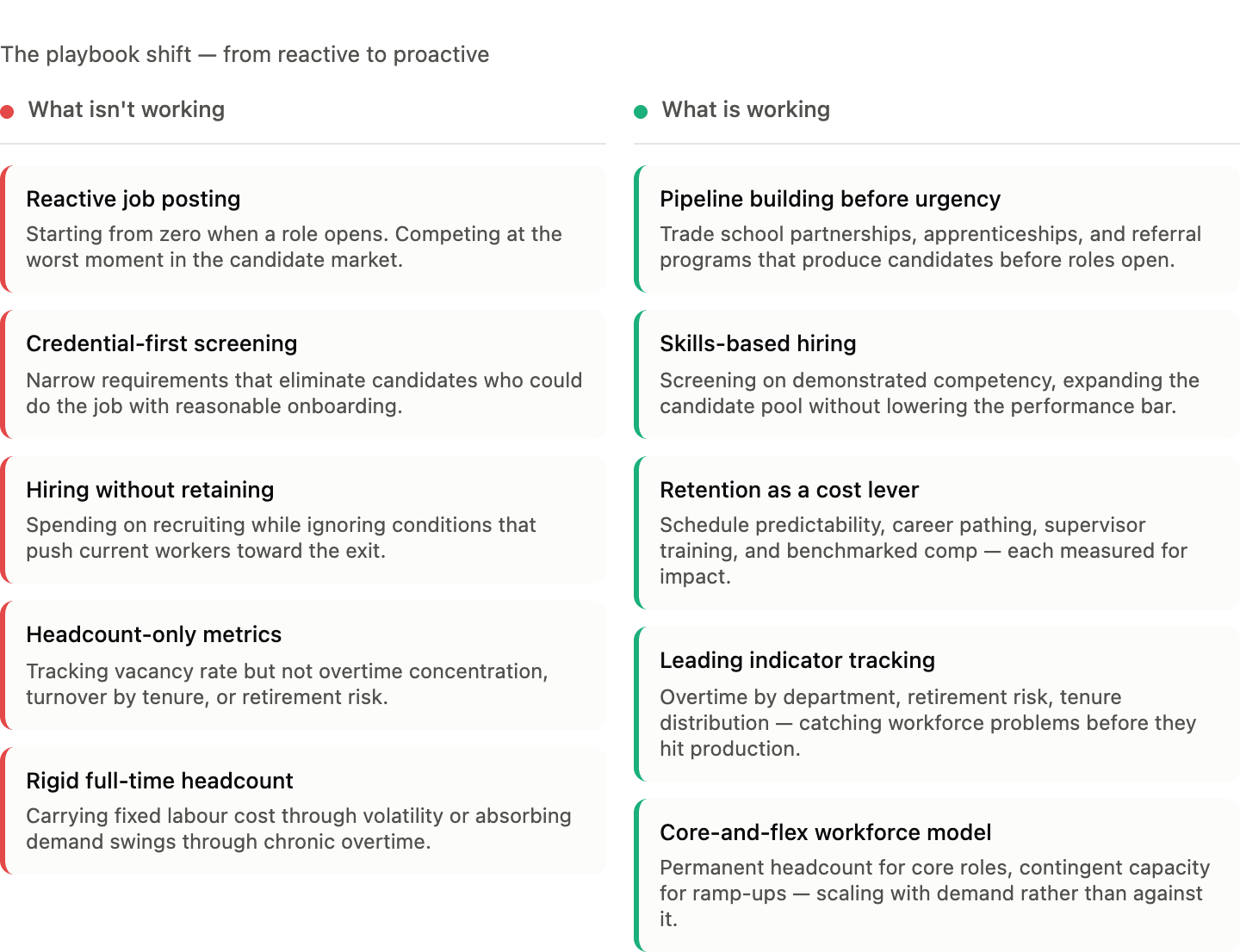 TPD has spent over 45 years partnering with manufacturing operations across North America. Our team works with both HR and operations leaders to build recruiting and retention strategies that address the structural realities of the current market, not just the immediate vacancy.
Tell us about your biggest retention challenge: we’ll map a strategy tailored to your operation.