
The numbers behind North America’s mining engineering shortage are stark enough that they’re worth stating plainly before anything else.
The United States has 15 accredited mining and mineral engineering programs. In 1982 it had 25. Enrollment has fallen 45% since 2015, leaving roughly 600 students across the entire country pursuing mining engineering degrees as of 2022. All of those programs combined produce fewer than 350 graduates per year. Meanwhile, more than half of the current US mining workforce is projected to retire by 2029, representing approximately 221,000 workers. Canada’s mining industry is estimated to face a shortage of 80,000 to 120,000 workers by 2030, with its own graduate pipeline declining by roughly a third between 2016 and 2020.
The math does not work. It has not worked for years. And the industry demand side of that equation is not shrinking, it’s accelerating, driven by critical mineral requirements for clean energy, defence, and advanced technology that will require an estimated 350 new mines to be developed across North America over the next 20 to 30 years.
The pipeline is broken. The operations doing best in this environment have stopped waiting for it to fix itself.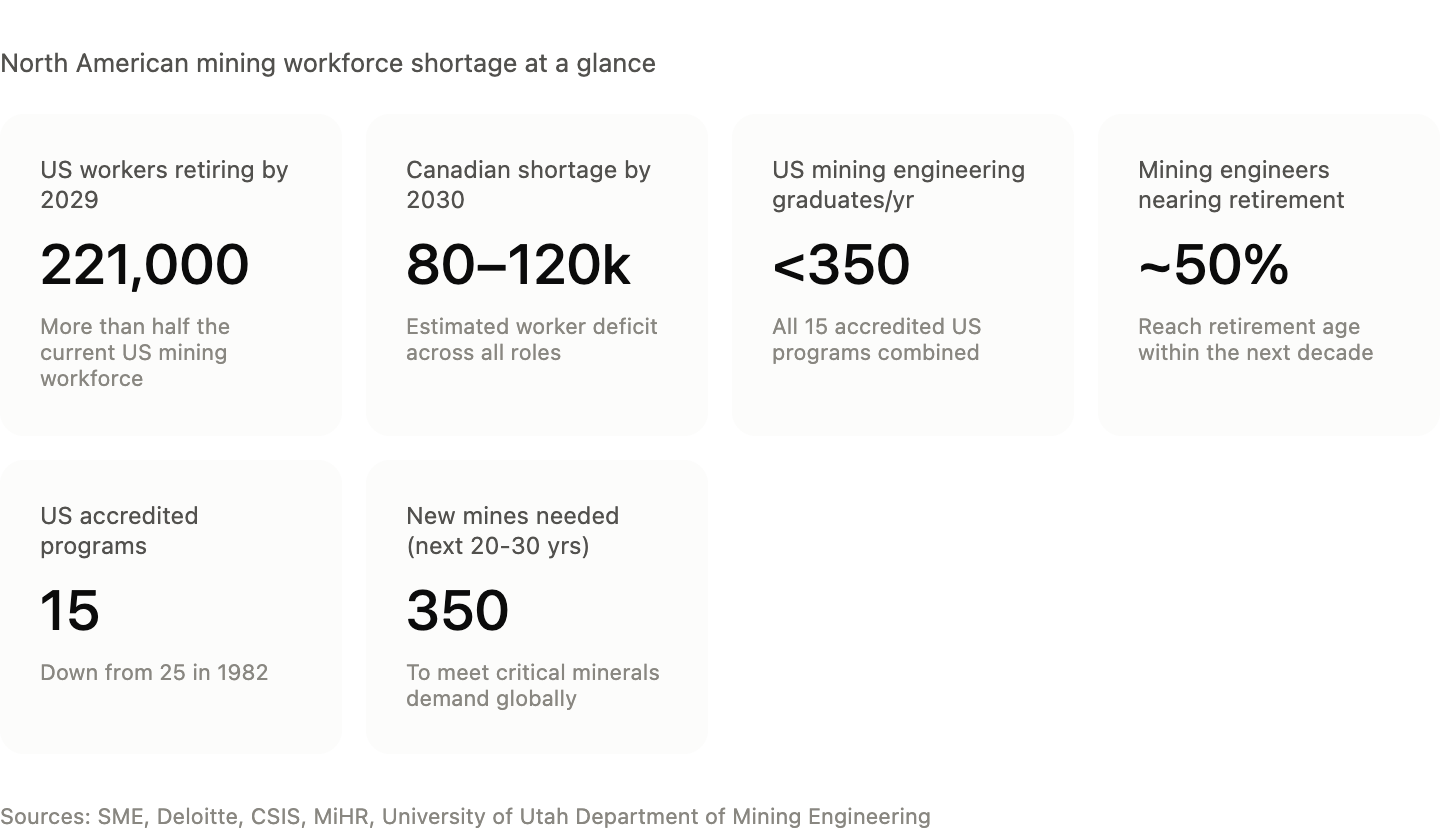
Why the Pipeline Collapsed
Understanding what happened to the mining engineer pipeline matters because it shapes what’s actually possible to do about it.
The decline in US and Canadian mining engineering programs isn’t random. Federal funding for mining research and education was dramatically reduced over several decades, removing the financial infrastructure that sustained programs at smaller universities. Faculty declined alongside enrollment: from approximately 120 mining engineering faculty members in the US in 1984 to around 70 by 2014: and the shortage of qualified candidates to fill those faculty vacancies has compounded the enrollment problem by reducing program capacity even at institutions still committed to the discipline.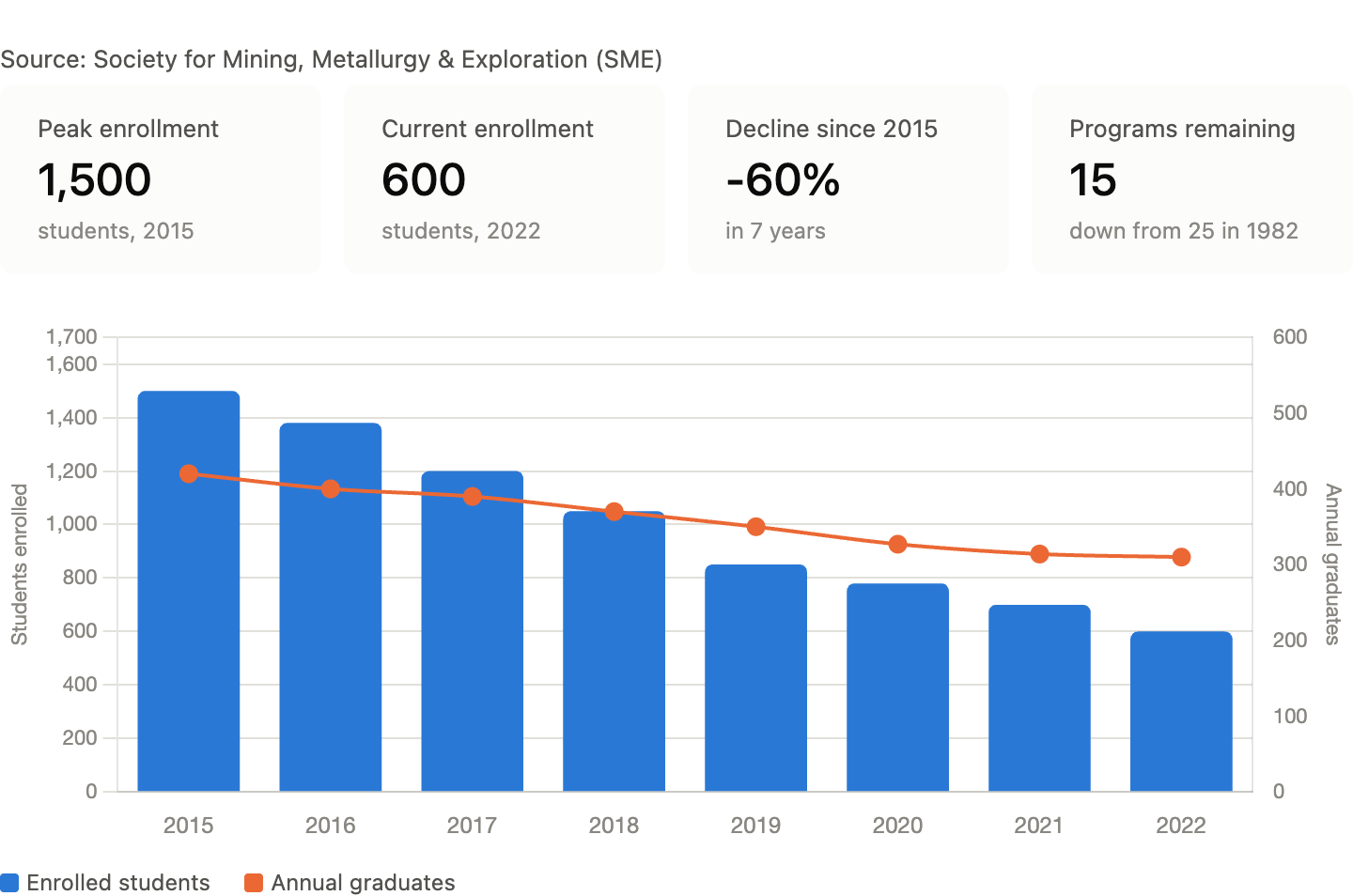
The perception problem has reinforced the pipeline problem. Mining has struggled to compete with technology, finance, and other engineering disciplines for the attention of the next generation of technically capable students. Younger people raised on environmental awareness and a different set of work values have historically viewed mining as an industry of the past rather than a sector central to the materials that make clean energy and digital technology possible. That perception is beginning to shift, particularly as the connection between critical mineral extraction and the energy transition becomes harder to ignore, but the shift is happening slowly relative to the urgency of current demand.
The result is a structural mismatch that no amount of reactive recruiting can fully bridge. The Society for Mining, Metallurgy, and Exploration has noted that the cost of retraining a civil engineer to do the job of a mining engineer is 600% higher than hiring a mining engineer directly. The qualified professionals that operations most need are genuinely scarce: not just difficult to find, but not present in sufficient numbers in the labour market regardless of what compensation is offered or how aggressively a company recruits.
What the Retirement Wave Actually Means for Operations
The retirement figures deserve more attention than they typically get in workforce planning discussions, because the issue isn’t just headcount. It’s the specific kind of knowledge that’s leaving.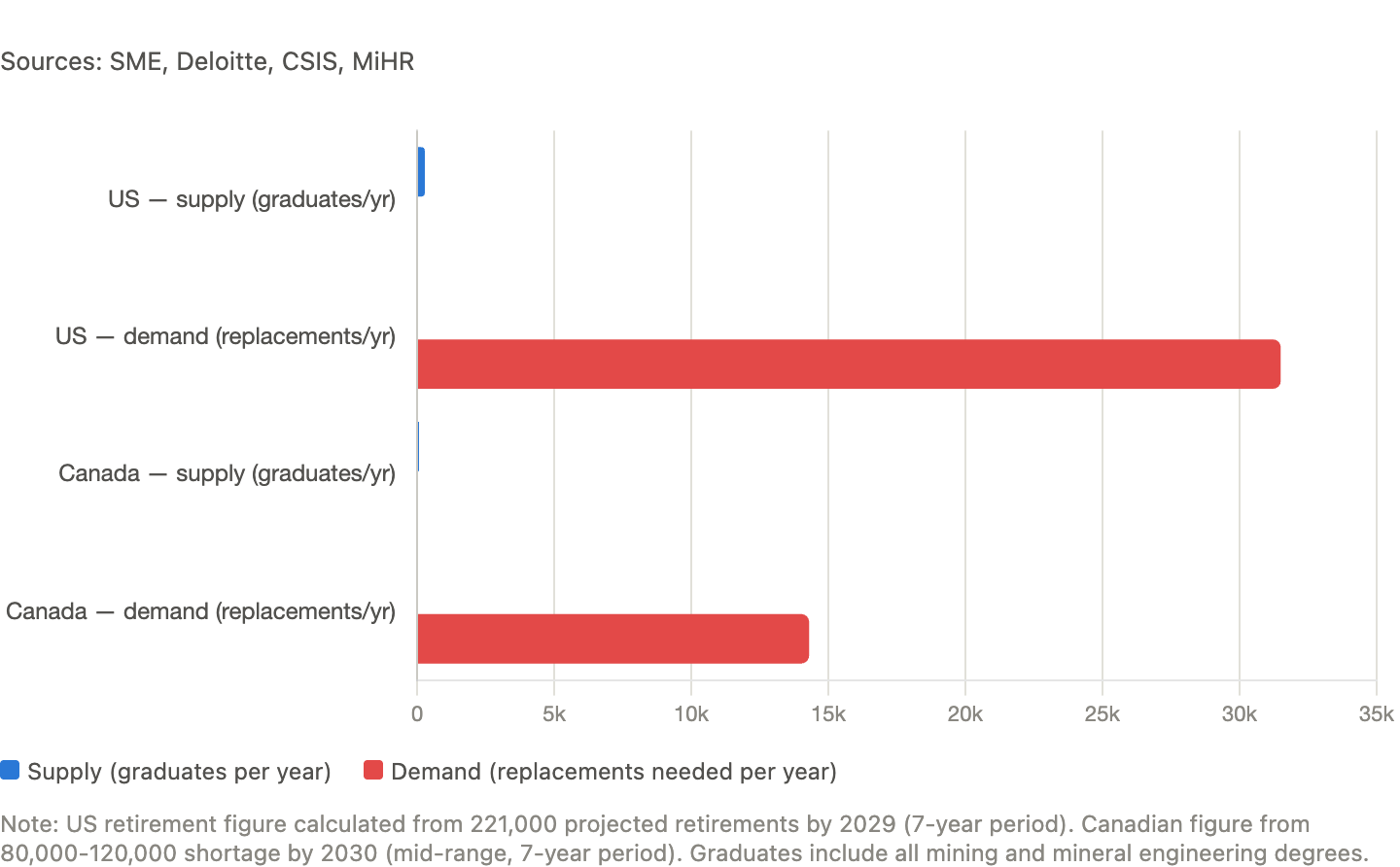
Nearly 50% of mining engineers in North America will reach retirement age within the next decade, according to Deloitte’s research. The average age of a US mine worker is 46. These are not entry-level workers stepping away: they’re the senior engineers, mine planners, metallurgists, and technical leads who carry decades of site-specific knowledge, operational judgment, and institutional memory that can’t be replicated by a hiring decision alone.
When a senior mine planner with 30 years of site experience retires, they take with them an understanding of the operation’s geology, its equipment history, its production patterns, and its failure modes that was never written down because it didn’t need to be: it was embedded in that person’s decision-making. Replacing the headcount is straightforward by comparison to replacing the capability. The companies that understand this distinction are the ones investing in knowledge transfer programs while they still have time, not after the retirement has already happened.
Permitting delays are another dimension of this that rarely makes it into workforce planning conversations. When government regulatory agencies can’t find qualified specialists to perform mandatory reviews, project timelines extend regardless of how well a mining company has staffed its own operation. The talent shortage in the professional pipeline affects the entire system through which new mines get approved and existing mines expand, not just the operations themselves.
What Operations Are Actually Doing
The mining operations navigating this environment most effectively share a set of practices that are producing results, even if none of them individually solves the structural problem.
The most immediate lever is adjacent talent sourcing, applied more deliberately than most companies have done historically. Civil engineers, geotechnical engineers, and geological engineers from oil and gas, construction, and environmental consulting carry fundamentals that transfer meaningfully to mining engineering roles with targeted onboarding. The discipline gap between a geotechnical engineer from a large infrastructure project and a mine geotechnical engineer is real but bridgeable, particularly for companies willing to invest in structured transition programs. The alternative is competing indefinitely for the same small pool of directly qualified candidates against every other operator in the market.
University partnership strategies are producing longer-term pipeline results at companies willing to invest the time. Sponsoring engineering students through school, establishing co-op and work-integrated learning programs that bring students onto mine sites during their studies, and funding applied research partnerships are all approaches that major operators are using to build familiarity with the industry in the student population before graduation decisions are made. BHP committed to 3,500 new apprenticeships and traineeships in Australia as part of an $800 million talent pipeline initiative. US registered apprenticeships in mining more than doubled from 411 in 2020 to 1,065 in 2021, reflecting early movement in this direction. The results of these investments take years to materialize in the workforce, but the operations that started them three years ago are beginning to see the benefit now.
Internal development pipelines are where the most operationally significant work is happening. Operations that have mapped their succession risk explicitly, identified the senior technical roles most exposed to retirement in the next three to five years, and built structured development tracks for the junior and mid-level engineers who could fill those roles are systematically reducing their single-point dependencies. This isn’t complicated in concept: it requires a clear picture of who’s retiring when, which roles that creates, and who internally has the potential to step into them with the right development investment. What makes it difficult is the discipline to execute when every team is already stretched and the day-to-day demands of running an operation crowd out long-term planning.
The integration of data science, geospatial analysis, and AI capabilities into mining engineering roles is also changing the sourcing calculus for forward-thinking operations. Modern mining requires people who can work with remote sensing data, optimize automated equipment performance, and apply analytical tools to production and geological problems that previous generations solved through experience alone. Candidates from adjacent technical fields, including geospatial technology, data engineering, and environmental science, bring capabilities that are increasingly central to how advanced mining operations function and who don’t require a mining engineering degree to contribute meaningfully.
The Recruiting Reality in a Broken Pipeline
For operations leaders and TA teams working within this environment, there are a few realities worth stating plainly.
The candidates most worth finding are almost never actively looking. The experienced mine planners, senior process engineers, and qualified geotechnical specialists who could step into your critical technical roles are employed, valued by their current organizations, and unlikely to surface through a job posting. Reaching them requires a recruiting partner with established relationships in the professional mining community and the credibility to have a conversation with someone who isn’t on the market.
Speed matters more than it used to. The small pool of qualified engineering candidates in circulation is being approached by multiple operators simultaneously, and the window between a candidate becoming available and accepting an offer elsewhere is shorter than it was five years ago. Operations that run slow, bureaucratic hiring processes for senior technical roles lose candidates they could have had to organizations that move decisively.
Compensation benchmarking needs to reflect what the market is actually doing, not what it was doing 18 months ago. A significant undersupply of qualified mining engineers has put upward pressure on compensation that hasn’t been fully absorbed into every organization’s internal bands. Operations discovering mid-search that their approved compensation range for a critical engineering role isn’t competitive are facing a problem that should have been identified and resolved before the search started.
TPD’s mining recruitment team works across North America to source technical and engineering talent for operations navigating exactly this environment. We maintain active relationships in the professional mining community, understand what qualified looks like for specific technical roles, and build our searches around the passive candidate market where the most capable people actually are.
Tell us about your critical engineering gaps: we’ll map a recruitment strategy. Connect with TPD’s Mining Workforce Manager, Simone Dorie at simone.dorie@tpd.com.