

Here’s What HR Leaders Need to Know
When a new copper or lithium project breaks ground, it doesn’t just create jobs. It competes for the same geologists, environmental professionals, engineers, and heavy-duty mechanics your operation has been trying to hire. And right now, those projects are multiplying faster than the talent pool that serves them.
The mining workforce conversation in 2026 tends to split into two tracks: the broad industry shortage everyone acknowledges, and the specific critical minerals buildout driving policy and capital. What that framing misses is the connection between them. For HR and talent acquisition leaders at mining companies, the critical minerals rush is not a separate story. It is the single biggest factor compounding an already tight labor market, and it is affecting your searches whether or not your company is in the battery metals space.
Why Critical Minerals Demand Is Unlike Anything the Industry Has Absorbed Before
The IEA’s 2026 Critical Minerals Outlook puts the scale of what is coming in concrete terms. Total critical mineral demand is projected to nearly double by 2040. Copper adds approximately 7 million additional tonnes, driven by electricity grid expansion, EV motors, and data center infrastructure, making it the largest demand increase by volume of any single mineral. Lithium demand grows more than threefold. Nickel and graphite are projected to grow between 50 and 90 percent.
Those numbers represent a sustained, multi-decade expansion of mining project activity that is already underway. Exploration spending is up. New project announcements are running ahead of historical averages. In the US, federal pressure to accelerate domestic critical mineral supply chains is compressing permitting timelines. In Canada, federal investment and provincial initiatives in Ontario and British Columbia are moving projects from feasibility to production on shortened schedules. Every one of those projects needs to be staffed from the same workforce your operation recruits from today.
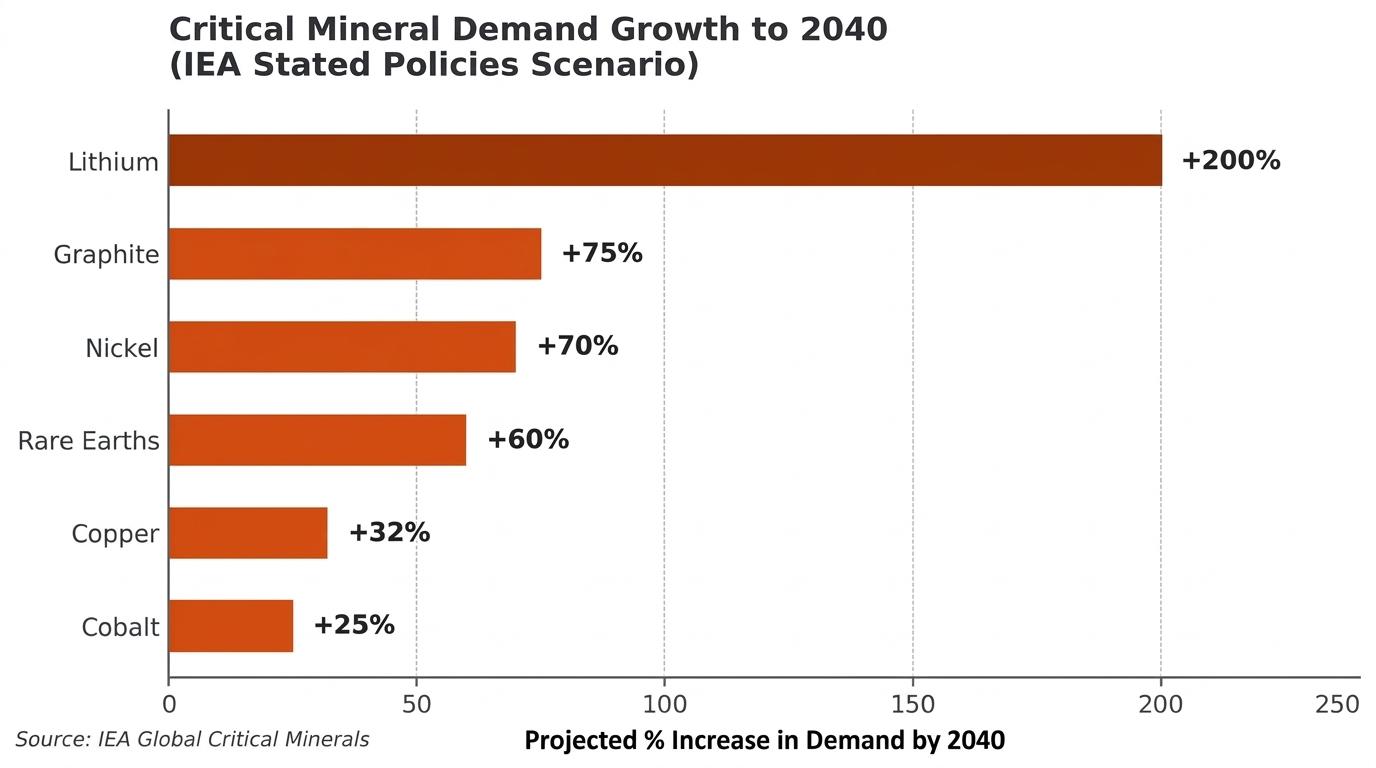
Critical Mineral Demand Growth to 2040 | Projected % increase by mineral type (IEA Stated Policies Scenario): Lithium +200%, Graphite +75%, Nickel +70%, Rare Earths +60%, Copper +32%, Cobalt +25%. Source: IEA Global Critical Minerals Outlook 2026
The Talent Spillover That Affects Every Mining Company
You do not need to be a critical minerals company for this to affect your hiring. The spillover works through the talent pool itself.
When a new lithium project in Nevada or a nickel development in Northern Ontario starts staffing up, it draws from the same regional base of geologists, environmental professionals, project managers, and maintenance technicians that established operations have been recruiting from for years. That base does not expand quickly. A geology degree takes four years. A heavy-duty mechanic with underground experience takes years to develop through the trade. These are not roles you fill by posting a job and waiting for applications.
The US mining vacancy rate climbed from 3.6% in 2018 to 5.1% by 2023. Canada’s nearly doubled over the same period, from 2.4% to 4.6%. Those figures reflect a labor market where available candidates are not keeping pace with demand, and the critical minerals buildout is adding pressure to a supply-side constraint that was already tightening before any of the major new projects started hiring.
Key statistics:
- 71% of mining leaders already report a talent shortage (McKinsey)
- 86% say recruiting and retaining talent is harder than two years ago (McKinsey)
- 36,000 open US mining vacancies as of April 2023, up from 27,000 one year prior (BLS)
- 66% of mining CEOs expect skill shortages to significantly affect profitability (PwC)
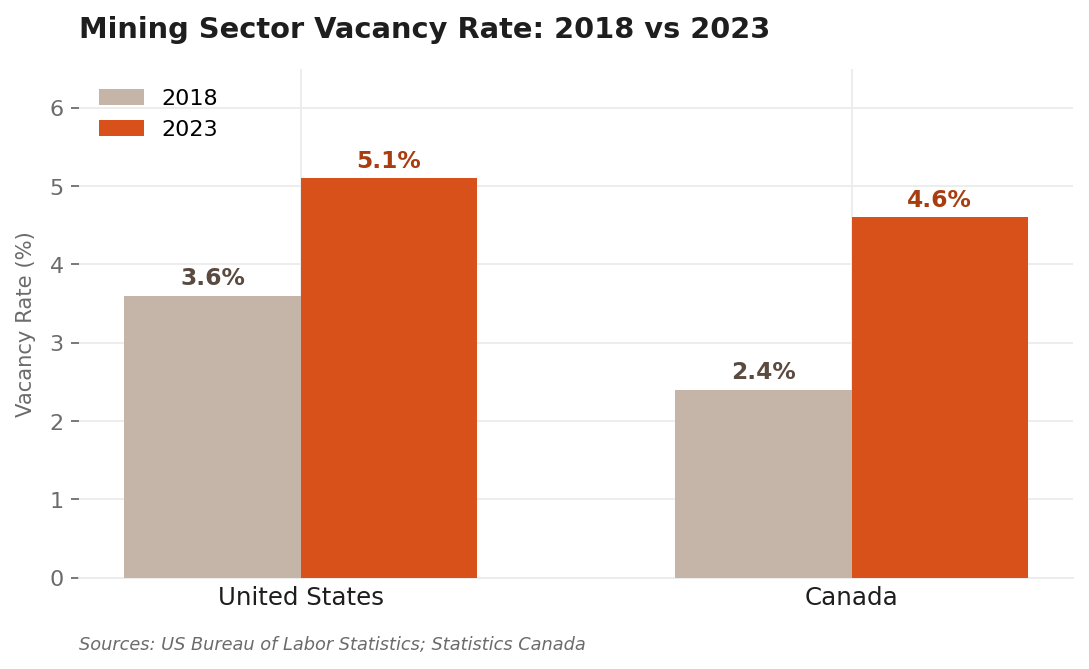 Mining Sector Vacancy Rate | US: 3.6% (2018) vs 5.1% (2023); Canada: 2.4% (2018) vs 4.6% (2023). Sources: US Bureau of Labor Statistics; Statistics Canada
The Roles Taking the Longest to Fill
The talent constraint falls unevenly across the skills your operation needs, and the divergence between the easiest and hardest roles to fill has grown significantly in the last two years.
General civil engineering positions fill in 45 to 60 days on average. Senior geotechnical engineers, specialists who work on pit slope stability and subsurface risk, now take 120 to 150 days, roughly triple the standard engineering search. Research indicates that 85 to 90 percent of qualified candidates are passively employed and must be reached through direct outreach rather than job postings. Mining automation and AI systems engineers are taking six to nine months to place, with fewer than two percent of active candidates carrying the required technical profile. Senior metallurgists with processing expertise relevant to copper and nickel operations have seen vacancy durations increase 40 percent year over year since 2023.
Geologists face a structural gap at both ends of the career lifecycle. About 27 percent of the US geoscience workforce is projected to retire by 2029. The American Geosciences Institute forecasts the US will be short 130,000 geologists by the end of this decade. Junior explorers across Canada and the US are already reporting that geologist and drill crew shortages are trimming program budgets and delaying fieldwork decisions, well before the larger critical minerals projects reach their peak staffing requirements.
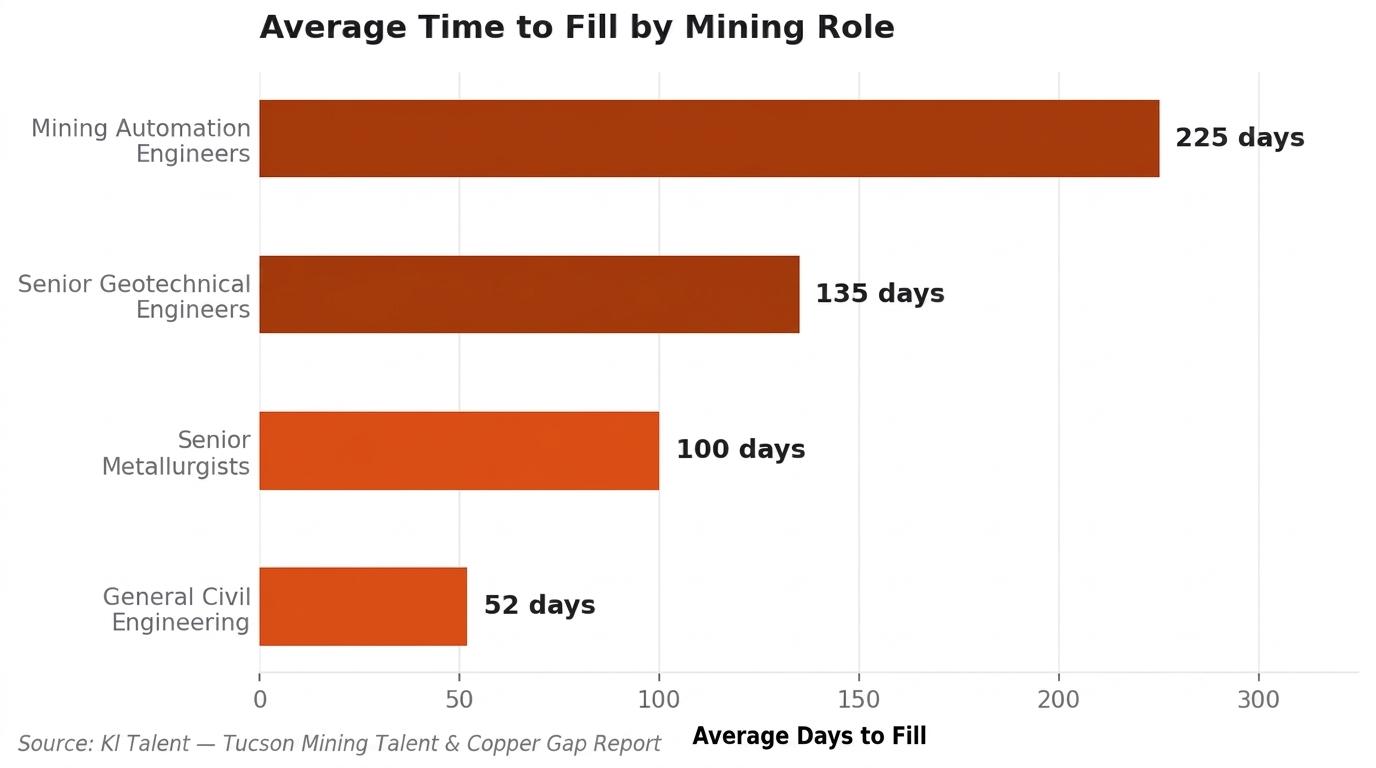
Average Time to Fill by Mining Role | General Civil Engineering: ~52 days; Senior Metallurgists: ~100 days; Senior Geotechnical Engineers: ~135 days; Mining Automation Engineers: ~225 days. Source: KI Talent, Tucson Mining Talent & Copper Gap Report
The Retirement Wave Making the Math Worse
The demand-side pressure from new project activity is compounding with a demographic reality on the supply side that the industry has known was coming and is now arriving at scale.
The average US miner is 46 years old. An estimated 221,000 US mining workers are projected to retire by 2029, according to research from Colorado School of Mines. In Canada, 20 percent of the mining workforce is 55 or older, while only 5 percent is under 25. In Arizona’s copper mining corridor, the median worker is 48.5 years old and 23 percent of the workforce becomes retirement-eligible within five years.
When experienced people leave, institutional knowledge goes with them, and the replacement timeline is not measured in months. A senior metallurgist’s process knowledge, built across a specific site and mineral type, is not transferred by an onboarding document.
The pipeline entering mining is thin and getting thinner. Seventy percent of people aged 15 to 30 say they would not consider a mining career. Canadian mining program enrolments fell from 1,400 in 2014 to 800 by 2020. The US awarded only 314 mining and mineral engineering degrees in 2021. Against a demand curve that is heading up, those numbers describe a structural constraint that will get worse before it gets better.
What HR and Talent Acquisition Leaders Should Do Now
The mining companies managing this well are not waiting to feel the gap before they build the pipeline. Three practices separate operations that are consistently staffed from ones that run long searches.
The first is extending the sourcing aperture before the need is urgent. Military veterans with mechanical, electrical, or engineering backgrounds are a consistently underused talent pool for site-based roles. Construction, oil and gas, and utilities are producing experienced tradespeople and technical professionals whose skills translate to mining with structured onboarding. The window to source those candidates closes when the vacancy opens and every competitor in the market is pursuing the same active candidates.
The second is treating compensation benchmarking as a quarterly practice rather than an annual review. The market for geologists, environmental professionals, and senior maintenance technicians is moving faster than most annual cycles capture. An offer built on last year’s data is frequently being declined against a competing offer built on current market intelligence, often before the hiring team realizes the benchmark has shifted.
The third is building a contingent layer before the surge arrives. Capital project timelines compress without warning. A pre-vetted bench of contract professionals, sourced and credentialed ahead of the urgent need, is what separates operations that hit their ramp dates from those that don’t.
Talk to TPD’s Mining Recruitment Team
The mining talent market is tightening, and the effects of the critical minerals buildout are running through the entire industry, not just the projects directly driving it. TPD’s mining recruitment team works with operations across Canada and the US on direct hire, contract, and project-based staffing for the roles that are hardest to fill: geologists, engineers, HSE professionals, environmental specialists, heavy-duty mechanics, and millwrights.
If your searches are running longer than they should, or your offers aren’t closing at the rate they used to, we would welcome the conversation. Let’s chat!
Elena Romero, VP of Growth
Elena leads TPD’s mining practice. With over 45 years of recruiting expertise behind the team, she works with operations leaders across North America on workforce strategies that hold up when production timelines are under pressure. If you are thinking through how to structure your talent approach for 2027, Elena is the right conversation to start.
LinkedIn: https://www.linkedin.com/in/elena-romero-cphr-shrm-scp-0727a110/